


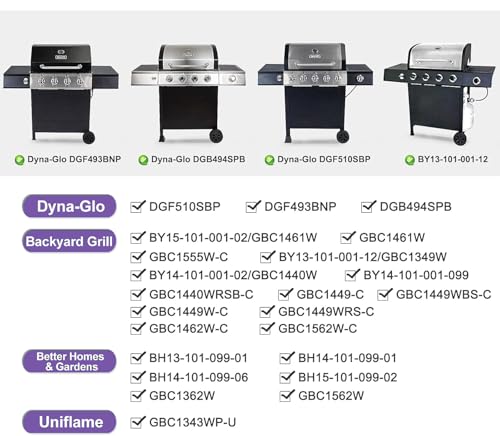


Dyna-Glo Grill Replacement Parts | Genuine OEM Components
Our stainless steel burner assembly is engineered to factory specifications for Dyna-Glo gas grills. Each burner tube features precise port spacing for even heat distribution across the entire cooking surface, with reinforced mounting brackets that resist warping under high heat. The assembly includes brass orifice fittings rated for both natural gas and LP conversion.
Designed for straightforward installation using standard hand tools, the burner ships with all necessary hardware and a detailed installation diagram showing port alignment and gas line connections. Compatible with Dyna-Glo 4-burner and 5-burner cart models manufactured from 2018 forward.
- 304 stainless steel tube construction resists corrosion and maintains shape
- Precision-drilled flame ports spaced to eliminate hot spots
- Brass orifice fittings included for NG and LP configurations
- Reinforced mounting brackets rated for 500+ heating cycles
- Ships with installation hardware and alignment template
OEM Parts vs. Universal Aftermarket Components
Dyna-Glo grill parts manufactured to our original equipment specifications ensure dimensional accuracy and material quality that universal aftermarket components cannot guarantee. OEM burners feature port spacing calculated for your grill’s BTU output and firebox volume, delivering the heat distribution our engineers designed into the system. Aftermarket burners often use generic port patterns that create hot spots or uneven temperatures across the cooking surface.
Material Specifications
Genuine replacement burners use 304-grade stainless steel with a minimum 0.035-inch wall thickness, providing structural integrity through hundreds of heating cycles. Heat tents carry our porcelain enamel applied at 1,500°F, creating a glass-hard finish that resists thermal shock and grease corrosion. The same cast-iron construction found in our cooking grate lineup extends to every wear component we manufacture, ensuring consistent performance as parts age.
Installation Requirements & Tools
Most Dyna-Glo grill parts install using standard hand tools found in a typical garage or workshop. Burner replacement requires a 7/16-inch socket or wrench to remove manifold connections, plus a Phillips screwdriver for mounting bracket hardware. Heat tent installation is tool-free on models with drop-in rails, while older cart grills may need a flat-blade screwdriver to release spring clips.
Gas Line Connections
When replacing burners or control valves, we recommend applying a thin coating of approved pipe thread sealant to male NPT fittings before assembly. The sealant should be brushed only onto the first three threads, keeping the first thread clean to prevent sealant from entering the gas stream. After reconnecting the gas supply, perform a leak test using soapy water on all fittings — bubbles indicate escaping gas that requires retightening or sealant reapplication.
Maintenance Intervals for Common Components
Burner tubes typically require inspection every 12-18 months in moderate-use environments, with replacement recommended when port openings show significant enlargement from corrosion or when flame patterns become irregular. Grills used year-round in coastal climates may need burner replacement every 18-24 months due to accelerated salt-air corrosion, even with stainless construction.
Heat tents last 2-4 years depending on cooking frequency and grease management practices. Tents showing rust perforation at stress points or extensive porcelain chipping should be replaced to restore proper heat distribution and prevent grease fires. The porcelain coating degrades faster when grease accumulates on the surface, so scraping tents clean after every 4-5 cooks extends their service life.
Essential Replacement Components for Your Dyna-Glo System


What people are saying
Common Questions About Dyna-Glo Replacement Parts
Check the model number plate on your grill's right cabinet panel for the complete model designation (DGE-XXXXX or DGF-XXXXX format). This number determines burner dimensions, orifice sizing, and mounting hardware compatibility.
Most parts pages list compatible model numbers in the product specifications. For burners and heat tents, your grill's burner count must match the part listing — a 4-burner grill requires a 4-burner heat tent set. Control valves and igniters are typically universal across all models within the same series and manufacturing year range.
No, natural gas and LP orifices are sized differently to deliver the correct fuel-to-air ratio for each gas type. NG orifices have larger openings to accommodate natural gas's lower pressure (7 inches water column vs. 11 inches for LP).
Using the wrong orifice creates unsafe operating conditions — an LP orifice on natural gas starves the burner of fuel, while an NG orifice on LP delivers excess gas that produces yellow flames and soot. Each burner assembly ships with orifices sized for one fuel type, indicated by color coding on the orifice body. Conversion orifices are available separately if you need to switch fuel types.
Stainless steel burner tubes last 3-5 years with regular use in typical residential environments. Coastal locations with salt air may see 2-3 year lifespan due to accelerated corrosion, even with stainless construction. Grills used daily or year-round experience faster port erosion than seasonal-use grills.
Burner life depends heavily on maintenance — keeping ports clear of debris and spiders prevents localized overheating that degrades metal. Covering your grill between uses blocks moisture and insects from entering burner tubes, extending service life. Inspect burners annually for port enlargement, rust perforation, or flame pattern irregularities that indicate replacement is needed.
Heat tent sets include the correct number of tents for your grill's burner count (4-piece or 5-piece sets match 4-burner or 5-burner models). Each tent ships with mounting hardware if your model uses screws or clips, though most current Dyna-Glo grills use drop-in tent installation that requires no fasteners.
The set includes only the heat tents themselves — burner tubes, grease tray, and cooking grates are sold separately. Installation takes 5-10 minutes and requires removing existing tents from their mounting rails or clips.
Most replacements install using common hand tools. Burner replacement needs a 7/16-inch wrench or socket for gas line connections and a Phillips screwdriver for mounting brackets. Heat tents, grease trays, and cooking grates are tool-free on drop-in models.
Control valve replacement requires a Phillips screwdriver to remove the control panel and a small adjustable wrench (6-inch or 8-inch) to disconnect the gas manifold. Ignition systems install with a Phillips screwdriver for electrode mounting. No specialized grill tools or welding equipment is necessary for any standard replacement part.
While physically possible, mixing OEM and aftermarket parts often creates performance inconsistencies. Aftermarket burners may have different BTU outputs or port spacing than OEM burners, causing uneven heat distribution if installed alongside genuine Dyna-Glo tubes.
Heat tents and cooking grates can be mixed more successfully since they're passive components, though dimensional variations sometimes create fit issues. For best results and warranty coverage, we recommend using genuine Dyna-Glo parts throughout your grill. Mixing parts from different manufacturers can complicate troubleshooting if performance issues develop.
Mix a 50-50 solution of liquid dish soap and water in a spray bottle. With the gas supply connected but all burners turned off, spray the solution onto every threaded connection you disturbed during installation — manifold-to-burner connections, valve-to-manifold joints, and tank-to-regulator fittings.
Watch for bubbles forming at connections, which indicate escaping gas. Any leaking connection must be disconnected, cleaned, resealed with fresh pipe thread sealant, and retightened before use. Never test for leaks using a flame or operate the grill if you smell gas around connections. Perform leak tests outdoors in a well-ventilated area away from ignition sources.